
February 6
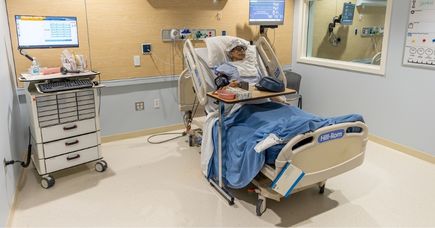
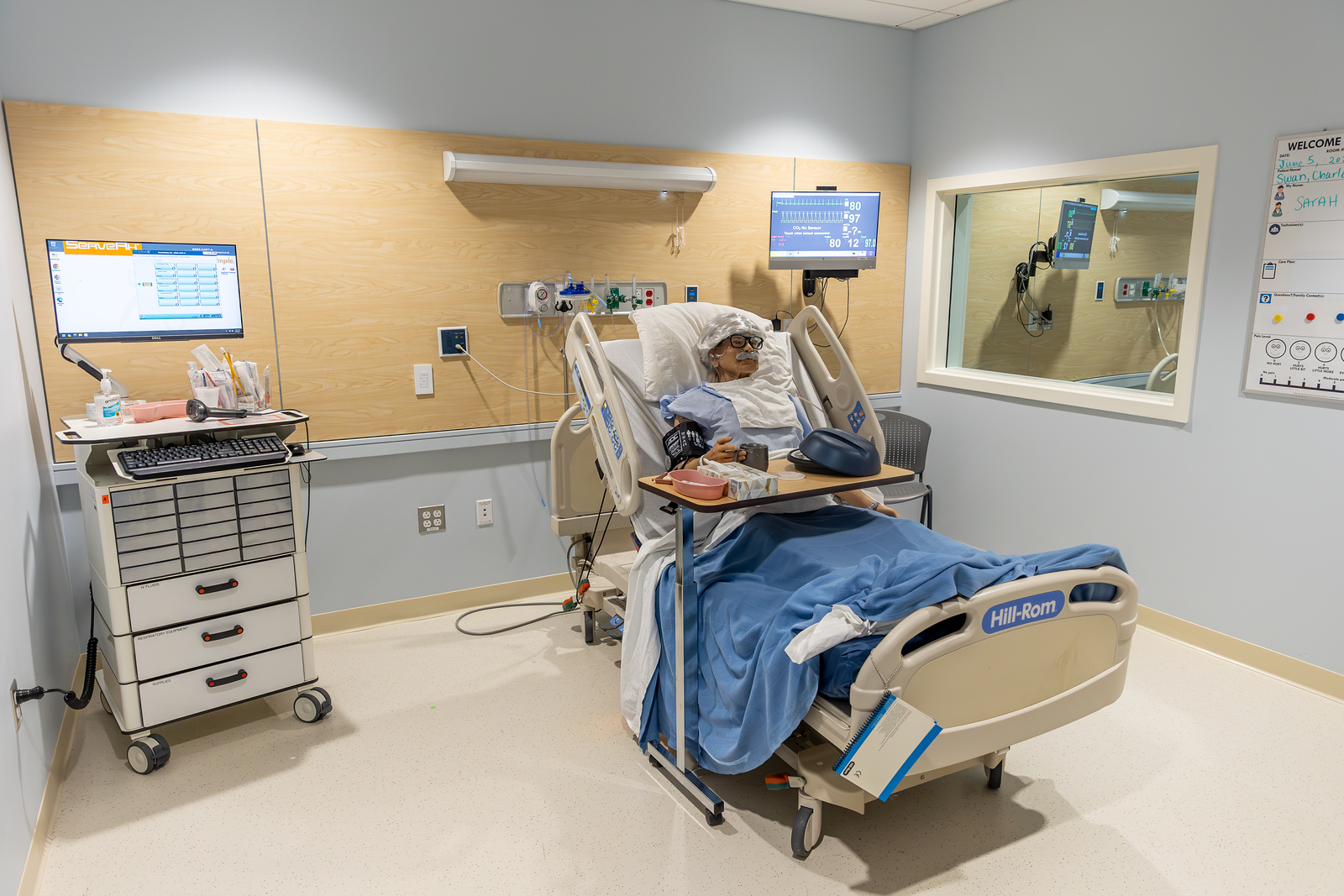
Carl Shapiro’s chest feels tight and painful, and he’s having difficulty staying calm. After landing in the emergency room, he’s admitted to the medical surgical floor, and nurses whip into action around him. The 54-year-old's breathing is short, and he anxiously waits for his wife to arrive.
This could be a scene in any hospital. The catch? Shapiro isn’t real, and the nurses administering medication and examining his chart are students completing a simulation at the Henderson-Bertolon Simulation Center at North Shore Community College (NSCC).
Shapiro and his heart problems may be fictional, but students at NSCC learn very real lessons about clinical reasoning, communication, and teamwork.
Simulations at the Heart of Learning
The Center’s comprehensive simulations prepare future healthcare professionals for the cases they’ll encounter in the field. Designed to look and feel like a real hospital, the Center has everything from crash carts to dietary trays, and with six simulation rooms—respiratory care, labor and delivery/NICU, pediatric, outpatient, and two medical/surgical rooms—students can put a variety of skills to the test.
“Clinical judgement, decision making, collaboration, communication are some of the most important concepts that are taught and modeled in the sim center—people aren't born with these skills, you need to practice them,” explained Heather Nelson, professor of nurse education. Nelson leads simulations for students studying to become registered nurses (RNs). In the nursing programs, students work through simulations beginning in their very first semester and ending with a capstone simulation.
Nelson and the rest of the team work hard behind the scenes to prepare for each simulation, drawing upon their experiences in practice to prepare realistic materials like medical records.
The simulation rooms contain sophisticated simulation manikins upon which students can practice measuring vital signs, intubation, inserting catheters, and other skills. Actors play the roles of the patients and their families, allowing students to practice the social and emotional skills they will use in practice every day.
As the simulation unfolds and students tackle the case, the team is hard at work behind the scenes. In the control room adjacent to every simulation room, team members control the manikin’s vital signs to simulate their condition and react to treatment.
Several simulations, including the cardiac simulation, involve both nursing students and respiratory care students, which fosters collaboration.
Practice Makes Perfect
Future healthcare professionals can expect to see many patients like the one in the cardiac simulation: the American Heart Association estimates that between 2017 and 2020, 48.6% of American adults had some form of cardiovascular disease.
During events like a cardiac arrest, every second counts. It's a high-stakes situation, but in a simulation, mistakes aren’t catastrophic—they’re an opportunity for growth. Simulations give students a safe place to make and learn from mistakes, which in turn builds confidence.
“I work in practice, and I work with new graduates. The feedback I receive is ‘I felt more prepared when I had my first cardiac arrest patient because of that simulation,’” said Nelson.
The Simulation Center is just one way NSCC prepares the next generation of healthcare
professionals to enter new careers and serve our community with confidence, proficiency,
and professionalism.