
May 6
Seven students from the North Shore Community College (NSCC) Honors program recently presented their Honors projects at the UMass Lowell Honors Symposium and the Massachusetts Undergraduate Research Conference held at UMass Amherst.
As a part of the Commonwealth Honors Program, NSCC’s Honors students go above and beyond: diving deeper into their studies, conducting original research, and taking unique and challenging courses. Honors students are required to maintain a 3.2 GPA or higher, and those who transfer to a Massachusetts state university or UMass school are guaranteed acceptance to that college’s Honors Program.
“Honors projects give students an opportunity to design and lead their own research projects, guided by a faculty mentor,” said Professor Billy Jackson, coordinator of the Honors program. “The presentations demonstrate the rigorous, original academic work that NSCC students complete in the Honors program.”
Interdisciplinary Project Award Winner
UMass Lowell Honors College faculty selected NSCC student Kelly Fouhey’s project “The Non-Traditionals” for the Interdisciplinary Project Award.
“Receiving the Interdisciplinary Project Award was certainly unexpected, especially with so many outstanding projects on display! It was hugely validating to have the positive feedback from UML Honors College faculty, and I feel honored to have been recognized,” said Fouhey, who studies liberal arts.
As a part of the Commonwealth Honors Program, NSCC’s Honors students go above and beyond: diving deeper into their studies, conducting original research, and taking unique and challenging courses. Honors students are required to maintain a 3.2 GPA or higher, and those who transfer to a Massachusetts state university or UMass school are guaranteed acceptance to that college’s Honors Program.
Kelly Fouhey, “The Non-Traditionals”
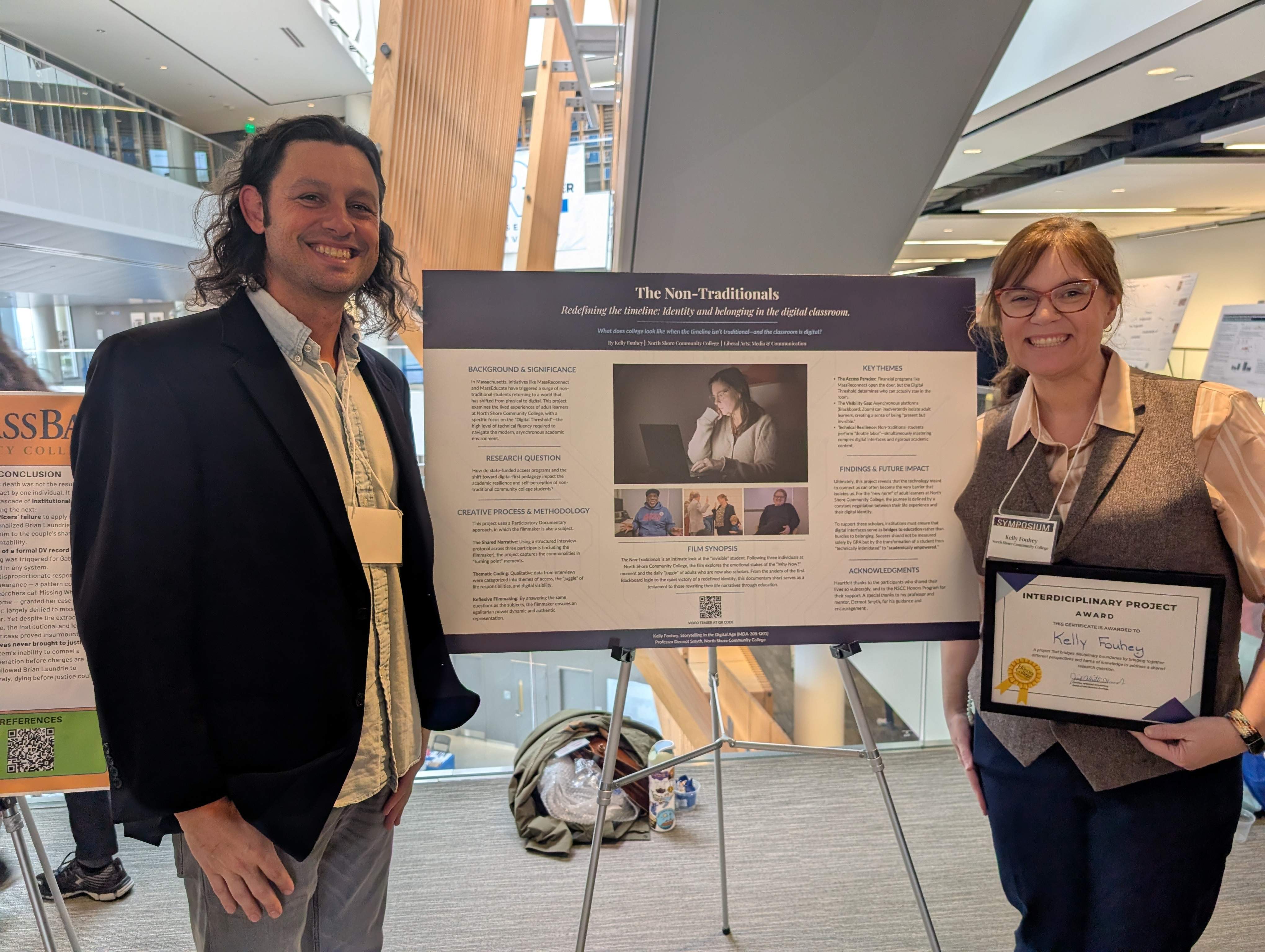
In her documentary “The Non-Traditionals,” Fouhey set out to answer the question, “What does college look like when the timeline isn’t traditional—and the classroom is digital?”
Now that community college is free for many Massachusetts residents, many nontraditional students have started on the path to a college degree.
“The Non-Traditionals” examines the lives of three nontraditional NSCC students (including the filmmaker herself) as they find themselves navigating a digital-first educational environment. These students often feel invisible as they work hard to learn both the technology and the content while juggling daily life with the demands of school.
“The highlight of both the documentary process and the symposium has been hearing about the diverse experiences of nontraditional students—we’re all working toward similar goals, but each ‘why’ reveals unique stories, challenges, and incredible character,” said Fouhey.
Shae McBride, “Emma and the Modern Drama via ‘The Ones Who Walk Away from Omelas’ by Ursula K. LeGuin”
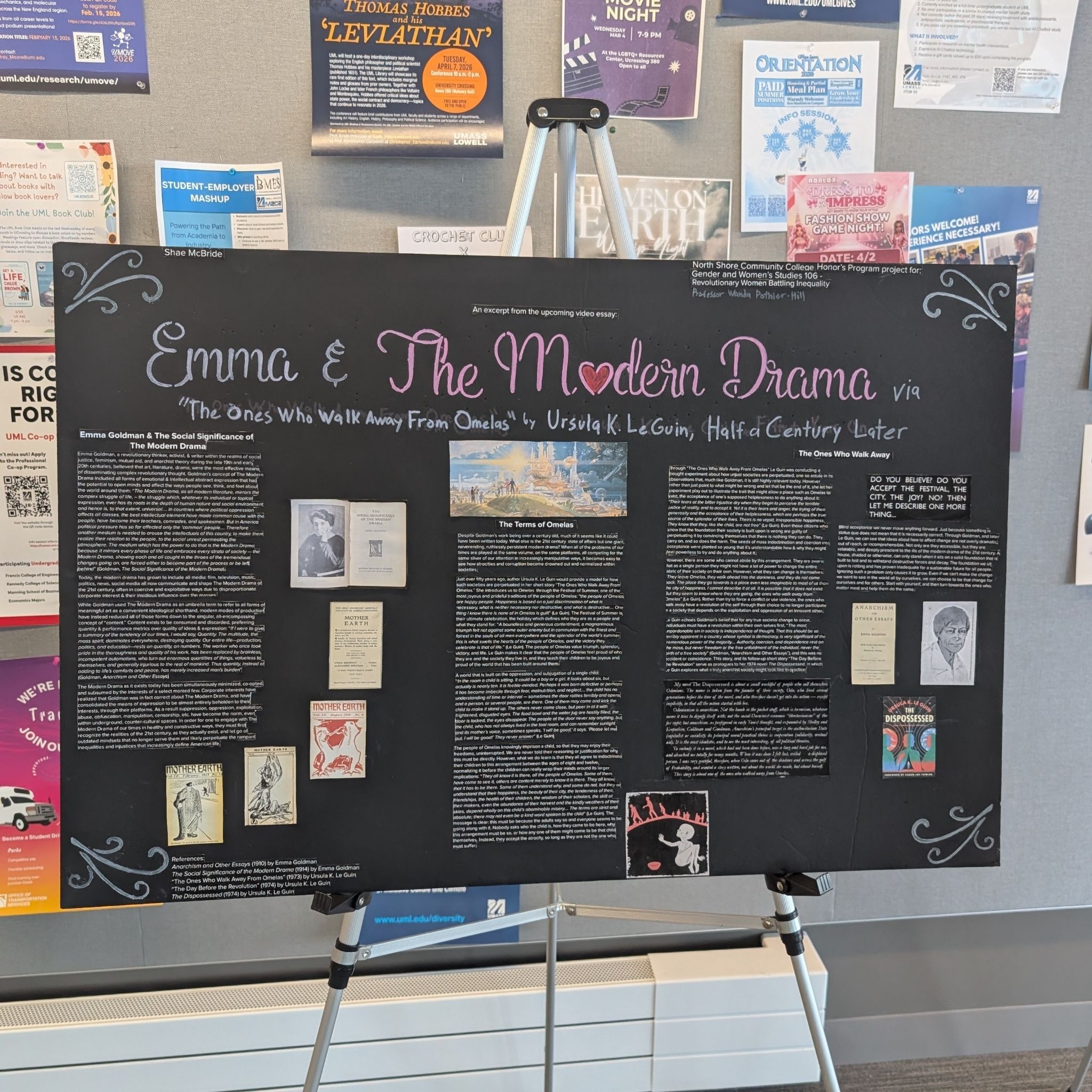
Communication and Media Studies student Shae McBride’s poster excerpts her upcoming video essay that examines Emma Goldman’s 1914 work “The Social Significance of Modern Drama” with Ursula K. LeGuin’s classic short story “The Ones Who Walk Away from Omelas.”
Goldman was a thinker, activist, and writer active in the late 19th and early 20th centuries. McBride’s video essay examines her concept of the Modern Drama, which “mirrors the complex struggle of life.” McBride argues that Modern Drama of the 21st century has exceeded plays to encompass all forms of media, with corporate interest dominating the modern media landscape.
McBride also examines LeGuin’s “The Ones Who Walk Away from Omelas,” a parable in which a beautiful city prospers but at a terrible cost. By comparing these two texts, McBride reveals insights about challenging the status quo.
Johnathan Channa, “A Gap in Memory”
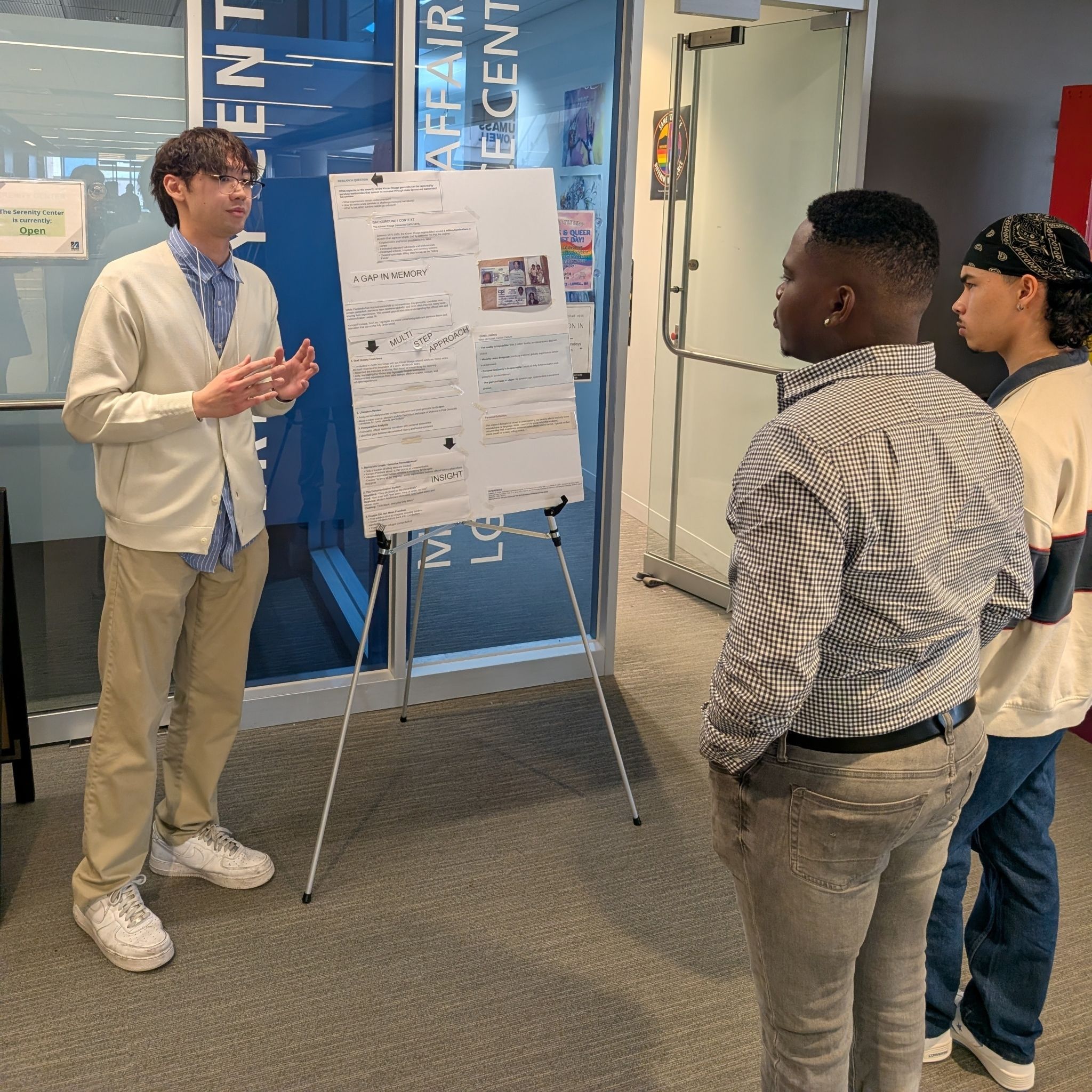
Liberal arts student Johnathan Channa presented on the ways in which survivor testimonies can reveal aspects of the Cambodian genocide not captured in state-sponsored memorials.
Between 1975 and 1979, the Khmer Rouge regime killed approximately two million Cambodians. Channa collected oral histories in Khmer from a survivor and a descendent and then translated the interviews into English, documenting experiences from labor camps, medical neglect, and refugee experiences.
In this project, Channa discusses various ways that the genocide is remembered in formal memorials and in living memory, the systems by which the Khmer Rouge dehumanized victims, and the challenges faced by refugees fleeing the regime. Many stories died with the Khmer Rouge’s victims, but personal testimony remains a powerful tool of remembrance.
“I felt comfortable talking about the uncomfortable, which was strange and exhilarating. Because of this work and event, I owe even more respect to my parents and anyone fortunate enough to be standing after this devastation, just because words are simply too basic to communicate the massacre they endured,” said Channa.
Katina Amirault, “My Feminist Rage”
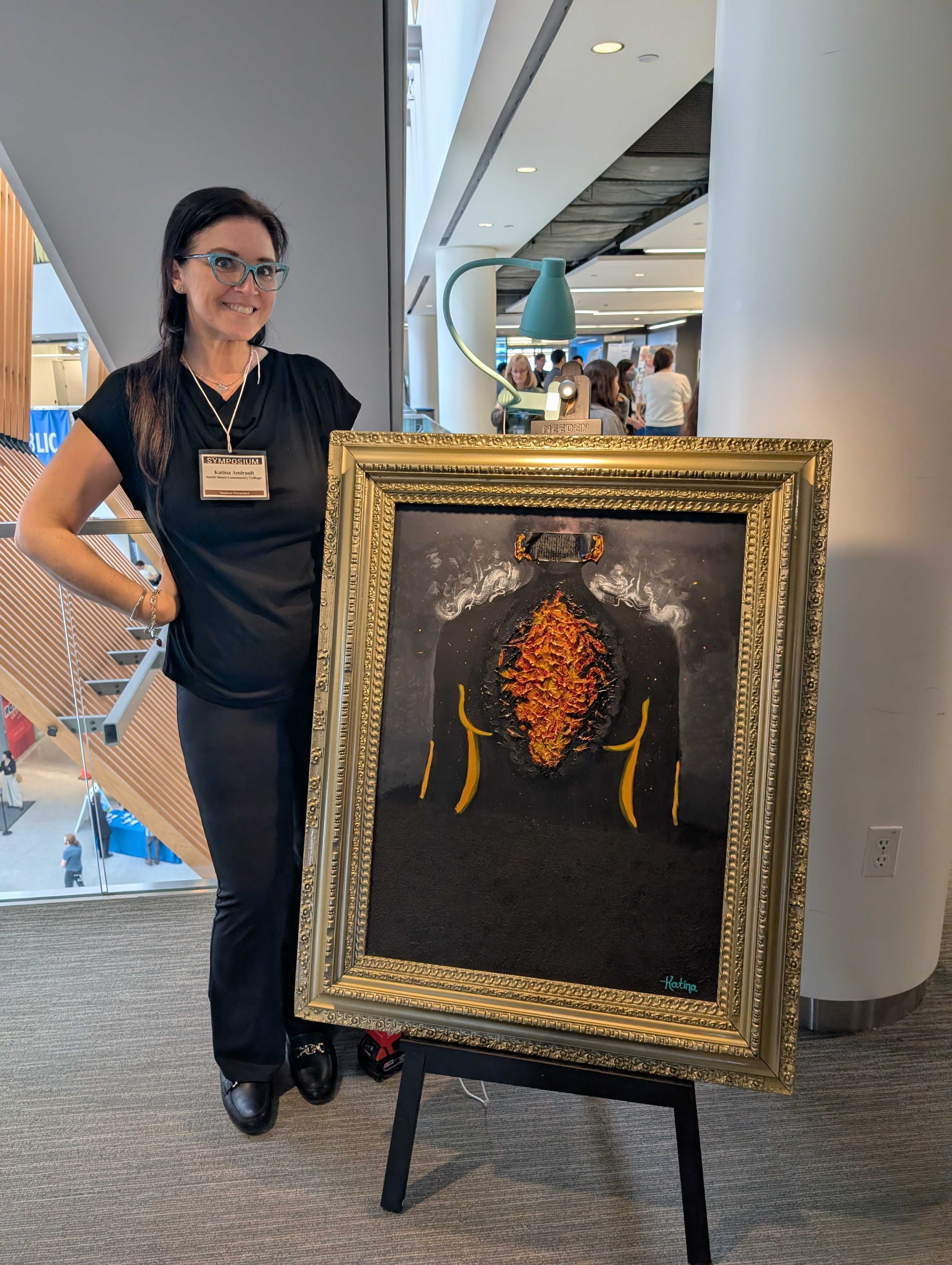
In an evocative piece of visual artwork, liberal arts student Katina Amirault utilizes composition and texture to express suppressed rage and internalized pressure. In this project, Amirault investigates how visual elements can create psychological impact for the viewer.
The background’s negative space, restrained color palette, and thin layers of paint are juxtaposed against the textured, fiery opening in the subject’s chest. A piece of duct tape closes the subject’s mouth, and further use of texture implies decay—the internal cost of the subject’s suppressed emotions.
“Presenting my original work at the symposium felt both empowering and vulnerable, as it brought a deeply personal idea to life after years of reflection. As an older student returning to school, I felt this was a particularly meaningful topic for me to explore. While it was a little intimidating being the only one presenting a painting, it also made the experience even more meaningful, and I was truly impressed by the creativity and thoughtfulness of the other students’ work,” said Amirault.
Ashley Shepard, “The Passive Neuronal Membrane as an RC Circuit”
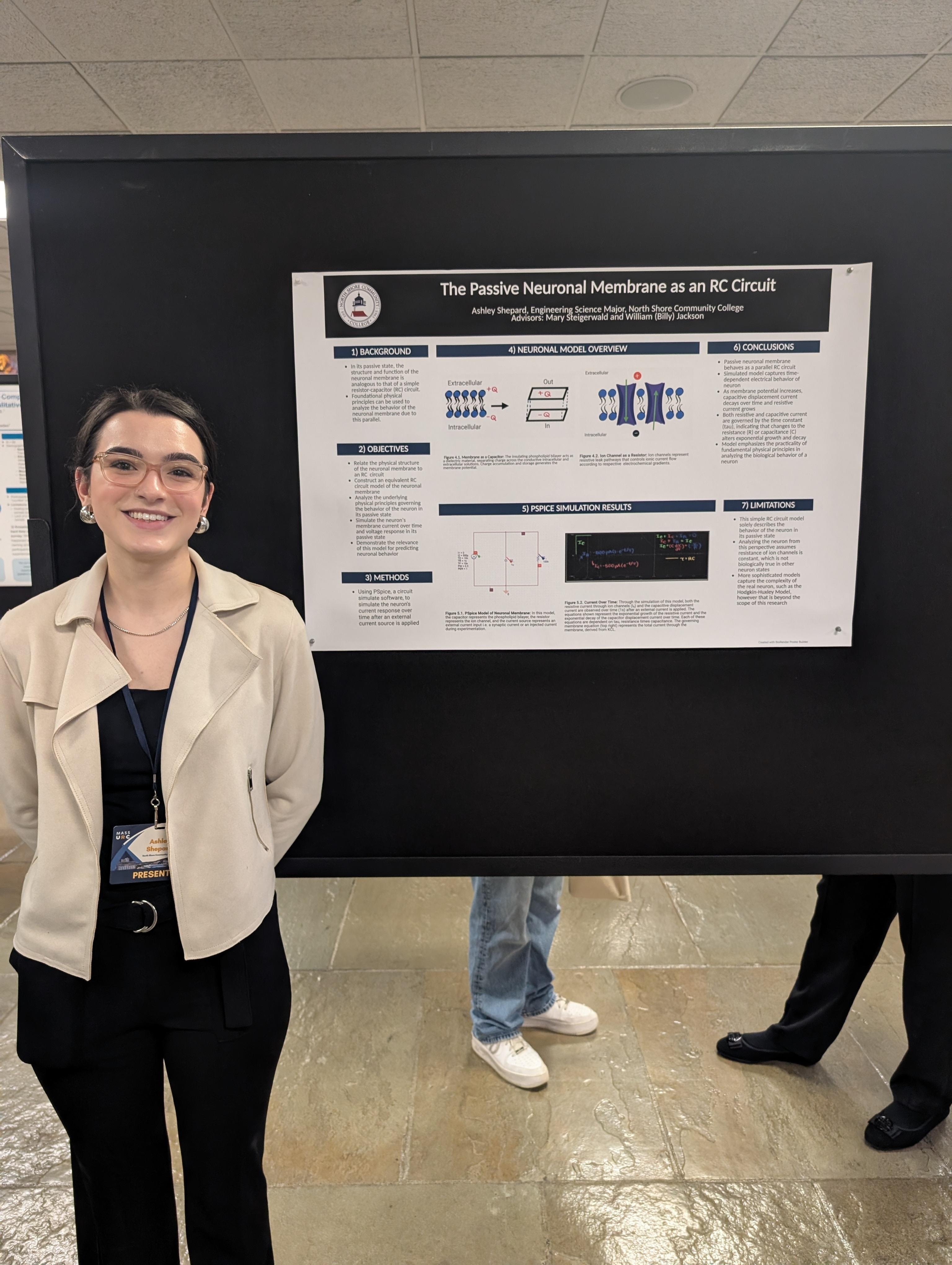
Engineering science major Ashley Shepard’s project focuses on the similarities between the cell membrane of a neuron and a resistor-capacitor (RC) circuit. Using the circuit simulation software PSpice, Shepard built a RC circuit model of a neuronal membrane in its passive state: the capacitor represents the phospholipid bilayer, the resistor represents ion channels, and the current source represents an external current input.
“This project was a stepping stone for my career as I hope to further refine the gap between neuroscience and engineering. While this project focuses on electrically modelling the neuronal membrane, my overall goal was to gain a better understanding of its physiological responses,” said Shephard.
Shepard simulated the neuronal membrane’s current over time and voltage response in its passive state. Through this model, she observed and analyzed the fundamental physical principles at play in the body’s nervous system.
“Especially as a first-generation college student, it was a proud moment to share an experience so academically and personally meaningful. Having my father there to support me and be a part of this significant milestone with me made it more impactful,” she said.
Bridget Ngu-Atem, "Early Detection of Dementia"
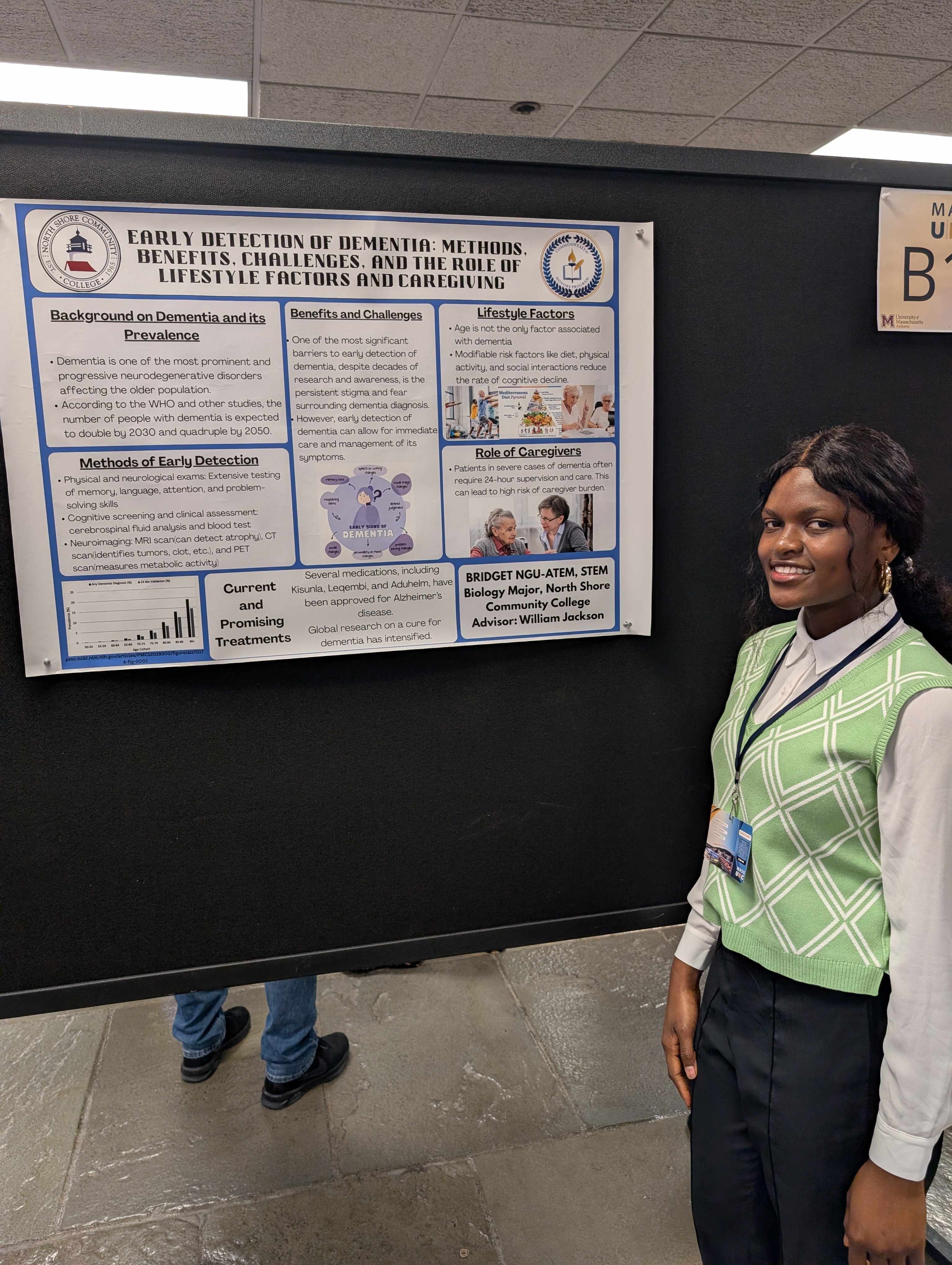
Bridget Ngu-Atem, a biology major, presented her project on dementia, a serious health issue: the World Health Organization predicts that the number of people with dementia will quadruple by 2050. Because patients with severe dementia often require round-the-clock care, the disease places a large burden on caregivers.
Ngu-Atem emphasized the importance of early detection through physical and neurological exams, cognitive screening and clinical assessment, and neuroimaging. Though fear and stigma related to dementia is a powerful barrier, modifiable risk factors like diet, physical activity, and social interactions can reduce the rate of cognitive decline, so early detection is crucial.
“I had an amazing experience during my poster presentation on dementia, as it showed me that many people are still not fully aware of the condition, its prevalence, symptoms, and the burden it places on caregivers. This poster presentation helped prepare me to become a more profound scientist by allowing me to effectively communicate my findings. I am grateful to NSCC and the Commonwealth Honors Program for giving me this opportunity to increase dementia awareness.”
Natalie Kowalski, “Love Hurts”
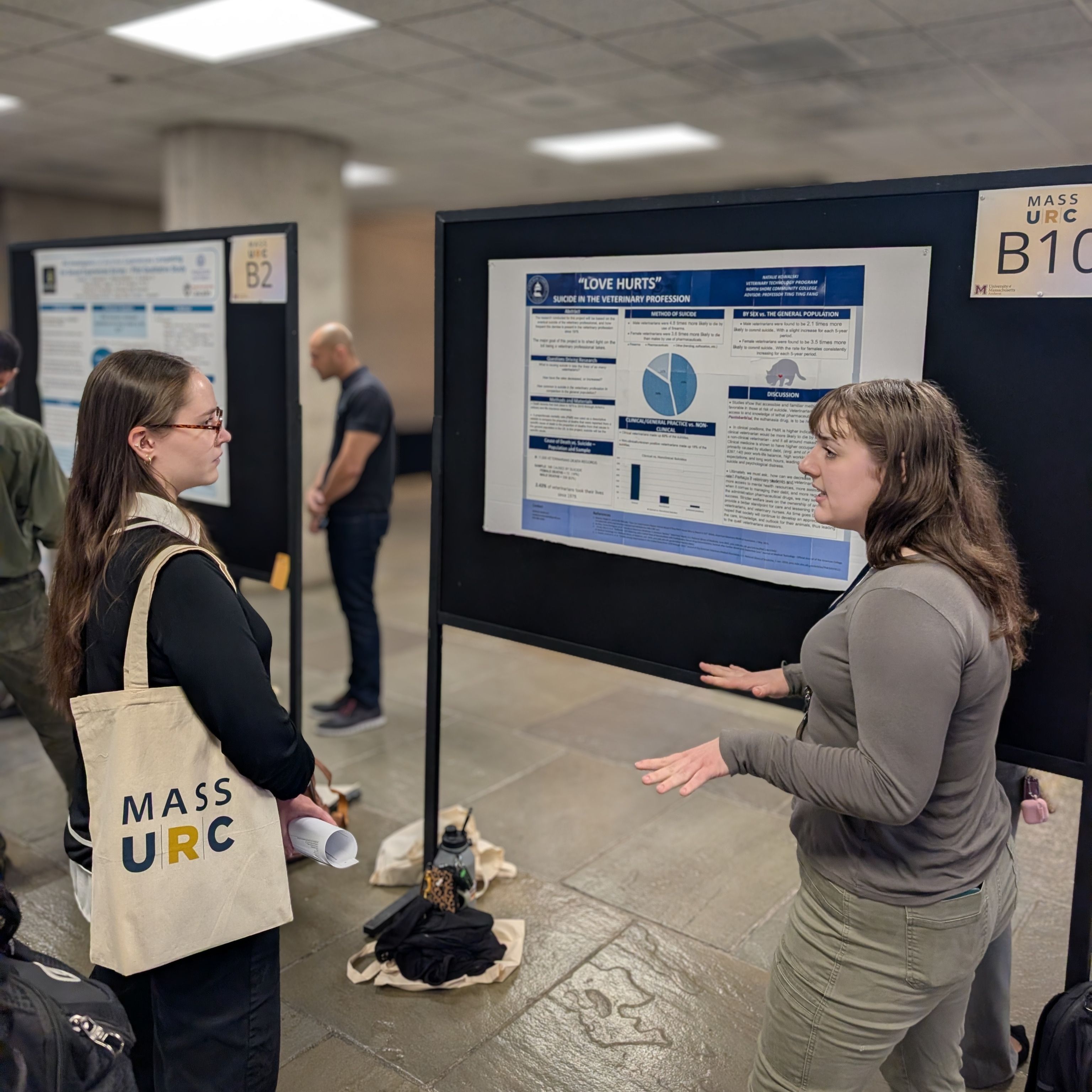
The veterinary profession can be a stressful one: veterinarians often deal with poor work-life balance, enormous student debt, and high client expectations. Veterinarians have a higher rate of suicide than the general population—a subject that veterinary technology student Natalie Kowalski delves into in her Honors project.
Using records that stretch from 1979 to 2015, Kowalski looked at several trends, including method, gender, and whether or not the veterinarian worked in general practice. By analyzing this data, Kowalski hopes to bring awareness to this important issue and advocate for mental health resources and regulations that may help address veterinarian suicide.
“The high percentage of suicides occurring in general practice was quite startling
and eye-opening to me,” she said. “It was wonderful to share a piece that coincides
with my concerns for veterinary medicine and to speak to brilliant minds.”